
Floral Series
The Floral Series is a collection of mixed-media and photomontage works in which flowers become a way of exploring memory, perception, human experience and contemporary life.
Some of the works have their beginnings in ideas I have carried with me for many years, while others respond to the world around me today. Flowers provide a recurring thread - symbols of beauty, fragility, growth and resilience - while the human stories within each image invite the viewer to look a little more closely.
How To Protect Yourself Against a Floating Vase of Flowers

This work began with an idea I had more than thirty years ago. At the time I was thinking about the enormous popularity of self-help books and the seemingly endless desire we have to find answers about how we should live our lives.
The original idea involved a book, partly because I was working in a bookshop at the time. But as the years passed, the book evolved into a mobile phone - a much more appropriate symbol for the world we live in now.
We are surrounded by advice. We search online for answers about relationships, happiness, health, success and almost every aspect of our lives. Social media gives us an extraordinary amount of information, but much of it is unedited, unchecked or completely unverified. We can be so busy looking for answers that we forget to look at what is actually in front of us.
The flowers in the work are beautiful and delicate, but there is something deliberately absurd about a vase of flowers floating above us as though it might fall at any moment. That contrast is important to me. Beauty can make us pause, but it can also disguise what lies beneath the surface.
The work asks questions about truth and illusion, information and wisdom, and our willingness to believe what we are told without looking for ourselves.
I also like the humour of the title. In a world full of serious self-help advice, perhaps what we really need is simply to look up, look around us, and occasionally question the vase of flowers hovering overhead.
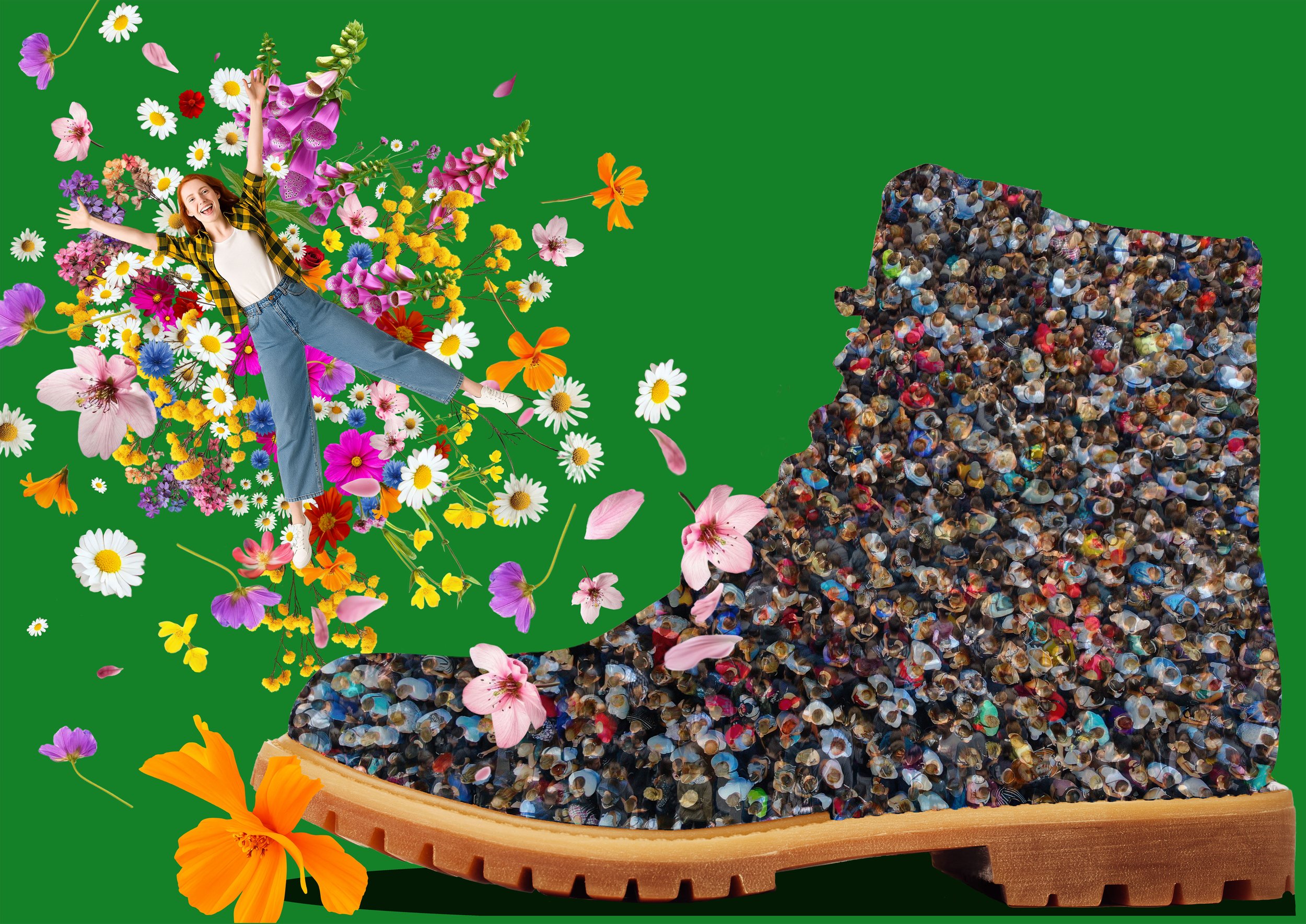
The One That Got Away
I made the original version of The One That Got Away as a large collage of images cut from magazines and newspapers when I was fifteen, while I was doing my O'Levels. It was the first time I exhibited something I had made with my mum, which makes the work particularly special to me. I no longer know what happened to the original collage, but the idea stayed with me.
The theme of escape has always fascinated me. I remember being particularly intrigued by the old nursery rhyme about the old woman who lived in a shoe. The idea of living in such a confined space gave me an almost claustrophobic feeling, and I have experienced a similar sense of being trapped at certain times in my working life.
The title The One That Got Away suggests something that has escaped - perhaps a person, an opportunity, an idea or simply the possibility of another life. I like the fact that it can be interpreted in many different ways.
Lovely Words grew from my feelings about the increasing division and hostility I have seen in the world over the past decade. So much of what reaches us seems designed to separate people - politically, socially and culturally - and it can sometimes feel difficult to find a way through all the noise.
Yet alongside all of this, there are still countless examples of kindness, generosity, friendship and people simply trying to make life a little better for someone else. I wanted to search for those quieter moments of positivity and hold onto the possibility that they might eventually become stronger than the negativity surrounding them.
The flowers bring beauty and softness to the work, while the words become something more than decoration. I find myself wondering: are the words disappearing into space, or are they being carried around the world?
Perhaps they are messages of kindness travelling further than we realise. Perhaps they are fragile thoughts that might easily disappear. Or perhaps, if enough of us speak kindly, they can become something lasting.
For me, Lovely Words is ultimately a hopeful work. It is about the possibility of connection, kindness and a safer, more peaceful future.

Lovely Words
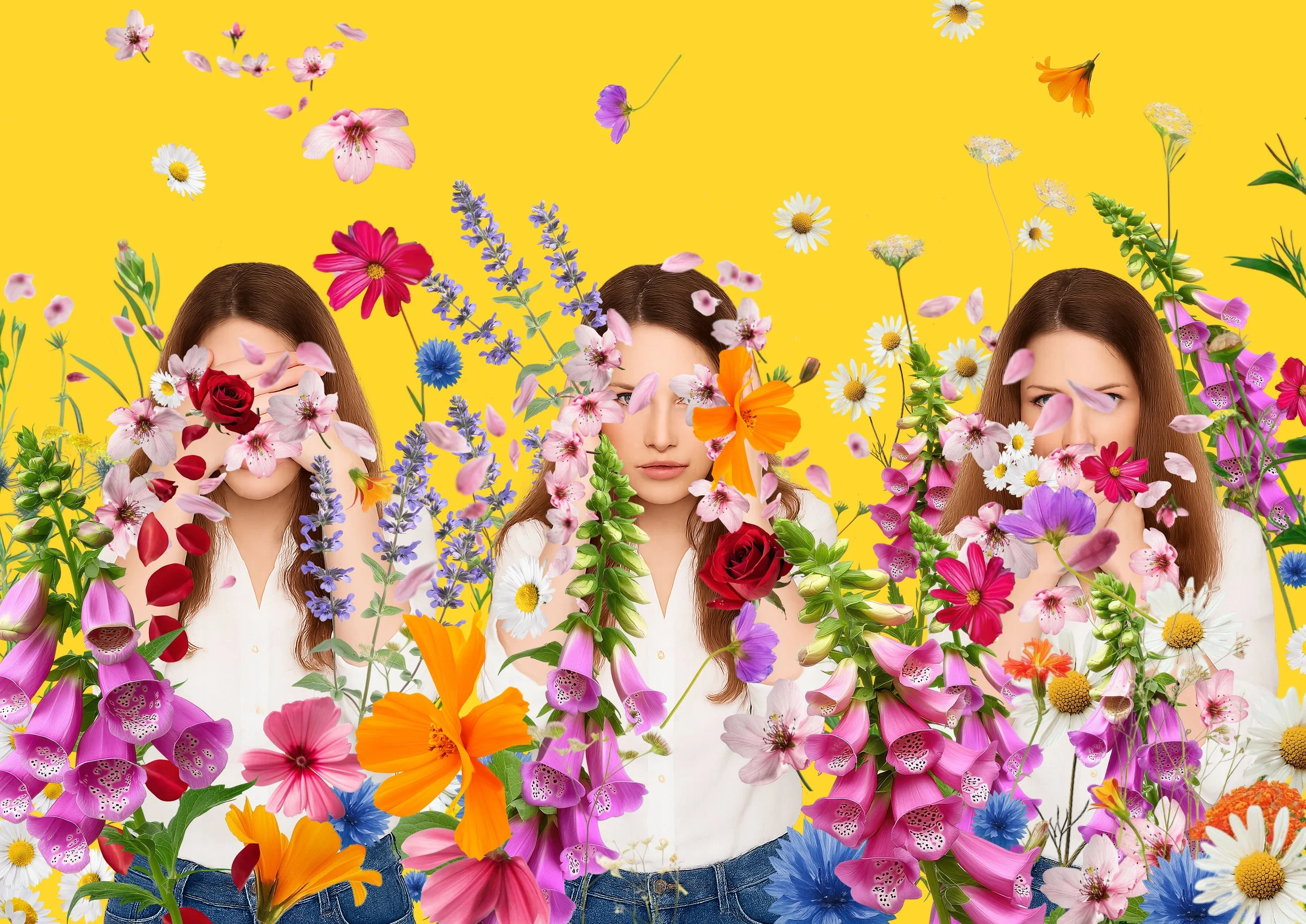
The Three Wise Monkeys
The Three Wise Monkeys began with the ancient teaching traditionally expressed as see no evil, hear no evil, speak no evil. I have always been fascinated by the way this simple idea has travelled across cultures and centuries, and by how its meaning has gradually changed.
The familiar three monkeys became particularly associated with Japan, where they are known as Mizaru, Kikazaru and Iwazaru. Their original message was one of moral restraint — being careful about what we see, hear and say. Over time, however, the monkeys have also come to represent something rather different: denial, turning a blind eye, or deliberately refusing to acknowledge what is happening around us.
That change in meaning feels particularly relevant today.
We live in a world where we are constantly surrounded by information, images and opinions. We can choose what we look at, what we listen to and what we repeat. But sometimes protecting our peace means knowing when to turn away from something harmful; at other times, refusing to look can simply mean refusing to face an uncomfortable truth.
I wanted to bring this old symbolism into a contemporary setting and leave the viewer to decide which interpretation feels most relevant.
For me, the three monkeys ultimately raise a simple question: how do we protect our peace without closing our eyes to the world around us?